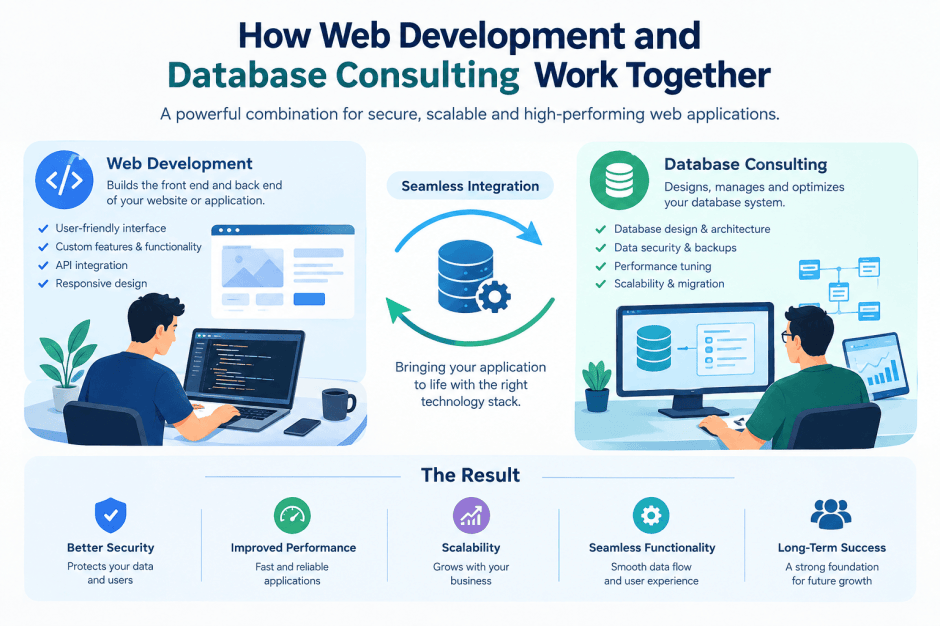
How Web Development and Database Consulting Work Together

Discover how white label web development services, database consulting services, and enterprise SEO services work together to create scalable, secure, high-performing websites.

Today I see that businesses need more, than a pretty website to succeed online. A strong digital presence relies on connected systems that run behind the scenes. Website development builds the platform. Database architecture keeps business data tidy. Search engine optimization shows the website to customers. When these parts run separately companies can suffer from speeds, technical glitches, low search ranking and hard maintenance.

Here I find that white label web development, database consulting and enterprise SEO become useful. By linking these skills businesses and agencies can make websites that run smoothly grow easily and back long‑term marketing aims. My research shows that companies now need development and marketing plans that work together than treating each digital service as a separate task.

Why These Three Areas Matter Together

Web development, databases and SEO handle issues but the outcomes they produce are very linked. A development team might create a website that looks great. If the database is not set up properly it can cause slow performance. Similarly an SEO team might find chances to appear in search results but technical problems can stop the website from using those ideas.

A good digital system starts with a technical base. The development part decides how people use the website. The database takes care of the data that makes the website work. Enterprise SEO then helps search engines understand the website and link its pages to the searches.

This connection is very important for companies that have thousands of pages, products, categories, locations, customer details or other organized information. According to market research when things get bigger the need, for automation, technical reliability and clean data handling grows.

The Role of White Label Web Development Services

White label web development services let agencies offer web building solutions while keeping their own brand. Agencies do not need an in‑house development team. A specialized development partner can take care of coding, integrations, website functionality, responsive interfaces, content management systems and other technical requirements.

This approach is useful, for marketing agencies, SEO companies, design firms and consultants who want to grow their service portfolios. Of hiring new developers for each project an agency can partner with a white label web development agency. The agency then shows the project to its client as part of its own service offering.

A solid white label development partnership must focus on clean code, design, functionality, performance, security and scalability. Developers also need to know that the website must support business and SEO requirements from the start.

How a White Label Web Development Agency Supports Growth

A white label web development agency can provide the expertise needed to turn strategy into a functioning digital platform. I have seen this happen time and again. For example an SEO agency may identify the need for landing pages, location pages, service pages or structured content templates. Developers can then build these components in a way that makes these components easy to manage and scale.

The development team can also create systems instead of producing every page manually. This approach becomes highly valuable for websites. A company managing hundreds of locations may need the layout across different pages while changing unique information for each market.

As per my knowledge efficient development is not simply, about writing code. White label web development agency involves creating an architecture that allows businesses to add features and content without rebuilding the entire website.

Understanding White Label Website Development

White label website development pushes this idea further letting agencies outsource entire website projects while still keeping control in front of the client. White label website development allows the agency to handle all communication, branding, strategy and project direction whereas the development partner focuses on the implementation.

This arrangement helps agencies serve clients and take on larger projects without raising internal overhead too much. White label website development also gives businesses a chance to tap into specialist development skills whenever their projects need custom functionality, integrations or advanced technical architecture.

A successful white label website development project needs communication, among the agency, client, designer, developer and SEO team. White label website development requires that all parties fully understand the websites goals before any development starts.

The Importance of a White Label Website Developer

I think a white label website developer plays a role in turning business needs into workable technical solutions. The white label website developer may work on interfaces, back‑end functions, APIs, content management systems, third‑party integrations, databases, and website performance.

However the white label website developer must also think about how technical choices influence SEO. URL structures, navigation, page rendering, internal linking, mobile performance, redirects, cano,nical tags and crawl accessibility can shape how search engines interact with the website.

When the white label website developer and SEO team talk early the white label website developer can stop technical problems before launch. This proactive approach usually builds a base, rather than fixing major SEO issues after the website is live.

Why Database Consulting Services Matter

When a business grows, its website starts to get more complicated. Companies might keep details about products, customer data, sales, stock, service records, places, news and other organized information. If there is no database structure, the website can slow down, become hard to fix, and hard to grow.

Database consulting helps companies figure out how to shape, keep, fetch, guard and care for their data. A database consultant services can look at the system, spot bad queries, suggest better designs, and help move data or connect systems.

How fast the database works can change how fast the website works. If the app takes long to pull data visitors will see slow page loads and laggy actions. So making the database faster helps the user feel good and keeps the site solid.

Connecting Database Architecture With Web Development

Web applications depend on databases to show content. Take a store for example. It pulls product names, prices, descriptions, stock levels, categories and customer details from a database.

To make this work developers must create connections between the web application and the database. If the queries are not well designed or if much data is requested unnecessarily or if there are duplicate records or if the database structure is not optimized performance can slow down.

A team effort, between developers and database specialists helps create systems that handle data smoothly. This is especially important when a business plans for growing traffic or needs to manage amounts of data.

How SEO Benefits From Strong Database Structures

Database architecture can have an impact on how well businesses handle SEO information. When databases are structured properly they can store things like page titles, descriptions, keywords, category details, location data, product features and other content fields in an organized way.

Developers can use this information to create parts of a website. This method can help big companies keep their SEO standards the same across thousands of web pages.

From what I have looked into automation is really useful when companies are dealing with websites that’re very large. Doing everything by hand can take up a lot of time. Make it easier for mistakes to happen. A good database gives teams a base, for handling lots of content more easily.

Performance Connects Development, Databases, and SEO

I see that website performance is a reason these three areas should work together. Developers can optimize code and frontend assets. Database consultants can improve query efficiency and infrastructure. SEO teams can monitor performance and search‑related impact.

A fast website gives users an experience and builds a stronger technical environment, for organic search. Businesses should evaluate performance across the technology stack, not just the visible design elements.

Caching, optimized media, efficient database queries, suitable hosting architecture, streamlined code and mobile‑friendly development all help boost website performance.

Scalability Should Be Designed From the Beginning

Businesses seldom stay the same size. A company might begin with a handful of service pages and later grow into many locations, many product categories, many markets, or many languages. A website architecture that fits 50 pages can struggle when the site grows to 50,000 pages.

That is why scalability matters during development. A white label web development company can build components, flexible templates, automated workflows and structured systems that make future expansion easier.

Database consultants can support scalability by designing data models and storage strategies, while enterprise SEO specialists can design scalable approaches for navigation, internal linking, content organization, and indexation.

Better Collaboration Creates Better Results

The biggest benefit of bringing these services is collaboration. Collaboration lets developers, database consultants and SEO professionals share their expertise. Collaboration gives each group a view of the other’s work.

When these teams talk, they can make choices together. Developers learn why certain technical features matter for SEO. SEO professionals learn about development limits. Database specialists make sure the data supports both the app and the content. Collaboration saves money by fixing needs before coding starts instead of after problems appear.

Choosing the Right Development and Consulting Partner

Businesses and agencies need to look beyond technical skills when choosing a development partner. They need to think about communication the ability to grow, security methods how projects are managed, the quality of documents and experience with complicated websites.

A good white label web development agency should also know how development links to marketing. When a partner knows about SEO and what databases are needed, it is easier to create websites that help reach business goals.

Agencies must also set expectations about who owns the work, when things will be done, how many changes are allowed, how testing will happen, how secure everything is, and what kind of support will be offered before starting a project.

Conclusion

Web development, database consulting and enterprise SEO should not work alone. They are parts of a digital system. White label web development services build the base database consulting services arrange and improve the information part and enterprise SEO services help companies get more visibility through search engines.

When these areas work together, companies can create websites that’re quicker, easier to handle bigger in size, and ready for future growth. According to research, companies that see technology and SEO as parts of their business can make better digital systems and change more easily as their online presence grows.

The aim is not just to start a website. The aim is to build a platform where development, data, performance, and search visibility help each other and lead to clear business results.

Gonzay.com Explained: Services, Blog & Digital Marketing Guide

What Is Gonzay.com? A Complete Guide to Its Services, Blog, and Digital Marketing Focus

If you’ve searched for gonzay com, you’ve probably noticed something odd: different sources describe it in different ways. Some call it a full-service digital marketing agency. Others describe it as a content and blogging platform covering technology, business, and lifestyle topics.

Gonzay.com operates as a digital media and marketing platform that publishes guides and articles across categories like SEO, technology, AI, business, and general lifestyle content, while also being associated with digital marketing and SEO-related services. Because the brand shows up in multiple contexts online, it’s worth breaking down exactly what people find when they search for it — and what to check before you rely on it for a guest post, a service, or advice.

This guide covers everything: what the site appears to offer, how its blog is structured, what to verify before trusting any digital marketing platform, and answers to the most common questions people have.

Why People Search for “Gonzay Com” in the First Place

People don’t land on this search term for just one reason. Based on how the term appears across the web, there are usually three types of searchers:

  • Content readers — people who found a Gonzay.com blog post (on AI, business, tech, or lifestyle) and want to know more about the site behind it.
  • Business owners — people researching Gonzay.com as a possible digital marketing or SEO service provider.
  • Writers and marketers — people checking the site before submitting a guest post, backlink request, or partnership inquiry.

Understanding which group you’re in helps you know what to look for.

What Does Gonzay.com Actually Offer?

1. A Content Hub Covering Multiple Categories

Gonzay.com publishes articles across a fairly wide range of topics, including:

  • Technology & AI — pieces on artificial intelligence, chatbots, automation, and software tools.
  • Business — growth strategies, productivity tools, and finance-related guides.
  • Digital marketing — SEO basics, content strategy, and online visibility tips.
  • Lifestyle and general guides — broader informational content aimed at everyday readers.

This category spread is common for content platforms trying to attract varied search traffic rather than serve one narrow niche.

2. Association With Digital Marketing and SEO Services

Separately, the Gonzay name is also linked to marketing-agency-style services, including:

  • SEO setup (plugin configuration, on-page optimization, schema markup)
  • Content strategy and copywriting
  • Web design and performance-focused site improvements
  • Paid advertising and conversion-focused campaigns

Important caveat: because these two identities (content platform vs. agency) appear in different places online with different framing, it’s worth confirming directly with the site — via its official contact page — exactly which services are currently active and who is behind them before entering into any paid engagement.

How to Evaluate Any Digital Marketing Platform (Not Just Gonzay.com)

Whether you’re considering Gonzay.com or any similar site for services, a guest post, or advice, use this quick checklist:

  • Check for a clear About page — Does it name real people, a company registration, or verifiable history?
  • Look for contact transparency — A real business address, phone number, or verifiable email builds trust.
  • Read recent content quality — Are articles well-researched, accurate, and free of filler?
  • Search for independent reviews — Third-party mentions (not just the site’s own claims) matter more.
  • Verify service claims before paying — Ask for case studies, client references, or a sample of past work.

Gonzay.com at a Glance

AspectWhat’s ReportedWhat to Verify Yourself
Primary identityDigital content platform / marketing-related brandConfirm current focus via the site’s About page
Content categoriesAI, tech, business, digital marketing, lifestyleBrowse recent posts for topic accuracy and depth
Services (if offered)SEO, content, web design, paid adsRequest proposals, past work, and client references
Target audienceGeneral readers + small/medium businessesMatch against your own goals before engaging
Best used forGeneral reading, topic awarenessNot a substitute for vetted, verified agency partners

Common Questions About Gonzay.com

Is Gonzay.com a legitimate website?

It functions as an active, publicly accessible content site with articles across several categories. As with any platform you’re unfamiliar with, verify contact details, ownership information, and service claims directly before any paid engagement.

What kind of content does Gonzay.com publish?

Based on available categories, it covers technology and AI, business and productivity, digital marketing, and general lifestyle guides.

Does Gonzay.com offer SEO or marketing services?

The name is associated with SEO and digital marketing services in some listings. Confirm current offerings, pricing, and scope directly with the site before purchasing anything.

Can I submit a guest post to Gonzay.com?

Many content platforms accept contributor submissions through a “Write for Us” page. If Gonzay.com has one, follow its stated guidelines and confirm editorial standards before submitting.

Is Gonzay.com the same company in Australia and the USA?

Different sources associate the name with both regions. If this matters for your decision (for example, hiring a service provider), ask directly which entity or team you’d be working with.

How do I know if a digital marketing agency is trustworthy?

Look for verifiable case studies, real client testimonials you can independently confirm, transparent pricing, and clear communication before signing any contract.

Should I trust a website just because it ranks in search results?

No. Ranking indicates search visibility, not necessarily authority or trustworthiness. Always cross-check with independent reviews and direct verification.

What should I do before hiring any digital marketing platform?

Request a discovery call, ask for 2–3 verifiable client references, review a sample of recent work, and clarify deliverables and timelines in writing.

Does Gonzay.com cover topics beyond marketing?

Yes — reported categories include AI, general business, and lifestyle content, suggesting a broader publishing strategy rather than a single-topic blog.

Is there one definitive, official description of what Gonzay.com is?

Not consistently. Descriptions vary across sources, which is why direct verification through the site’s own official pages is the most reliable approach.

Conclusion: Key Takeaways

Gonzay.com is best understood as a digital content platform with a marketing-related identity, publishing articles across technology, AI, business, and lifestyle categories, while also being linked to SEO and digital marketing services in some contexts.

Before you engage with any site like this — whether as a reader, a guest contributor, or a potential client — remember to:

  • Verify directly rather than relying on secondhand descriptions.
  • Check for transparency in ownership, contact details, and service claims.
  • Ask for proof — case studies, references, or samples — before paying for services.
  • Treat search visibility as a starting point, not a guarantee of quality or trustworthiness.

This approach applies not just to Gonzay.com, but to any digital marketing platform or content site you’re evaluating for the first time.

More Read: https://businesszone.news.blog/2026/08/01/how-to-plan-a-website-that-ranks-higher-converts/

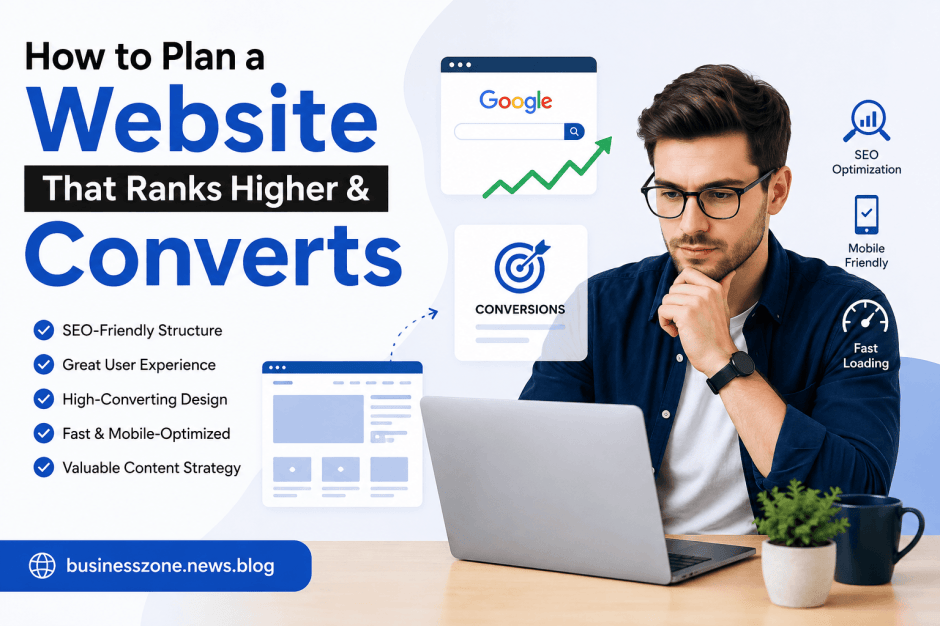
How to Plan a Website That Ranks Higher & Converts

  1. Start With Goals, Not Pages
  2. Research Keywords Before You Build the Sitemap
  3. Build a Search Engine Friendly Structure From the Ground Up
  4. Design for Conversion, Not Just Aesthetics
  5. Prioritize Site Speed and Core Web Vitals
  6. Plan Content Around Search Intent
  7. Don’t Forget On-Page SEO Basics
  8. Test, Measure, and Refine
  9. Final Thoughts

Most website projects fail before a single line of code gets written. The reason isn’t design, and it isn’t the developer’s skill — it’s planning. Businesses jump straight into templates, colors, and page counts without thinking about search visibility or visitor behavior. The result is a site that looks fine but neither ranks nor converts.

If you want a website that actually works — one that pulls in organic traffic and turns that traffic into customers — the planning phase matters more than anything else. Here’s how to do it right.

Start With Goals, Not Pages

Before you think about a homepage or an “About Us” section, define what the website needs to achieve. Is it lead generation? Ecommerce sales? Newsletter sign-ups? Every goal changes how you structure the site, what content you prioritize, and where your calls-to-action go.

A common mistake is building a site around what a business wants to say, rather than what a visitor wants to do. Flip that thinking. Every page should have a job: inform, persuade, or convert.

Research Keywords Before You Build the Sitemap

SEO isn’t something you sprinkle on after launch — it has to shape your site’s architecture from day one. Before mapping out pages, research the terms your potential customers are actually searching for.

Group these keywords into themes. Each theme typically becomes a page or a content cluster. This keyword-first approach prevents two common problems: pages that target nothing (and therefore rank for nothing), and multiple pages competing for the same keyword.

Build a Search Engine Friendly Structure From the Ground Up

Search engines need to crawl and understand your site easily, and visitors need to navigate it without friction. Both goals point to the same solution: a clean, logical structure.

This means:

  • A shallow hierarchy — important pages should be reachable within 2–3 clicks from the homepage
  • Descriptive, keyword-rich URLs instead of generic strings
  • Clear internal linking so authority flows to your priority pages
  • Mobile-first layouts, since most search traffic is now mobile

Getting this foundation right is exactly what’s covered in this guide on Search Engine Friendly Website Design, which breaks down the technical and structural choices that help search engines index your site properly while keeping the experience smooth for visitors.

Design for Conversion, Not Just Aesthetics

A visually appealing site that doesn’t convert is a wasted investment. Every page should guide visitors toward a decision:

  • Clear value proposition — visitors should understand what you offer within seconds
  • Obvious calls-to-action — buttons and links that stand out and use action-oriented language
  • Trust signals — testimonials, reviews, certifications, or case studies placed near decision points
  • Reduced friction — simple forms, fast load times, and no unnecessary steps between interest and action

Conversion-focused design isn’t about flashy visuals. It’s about removing every obstacle between a visitor’s intent and their action.

Prioritize Site Speed and Core Web Vitals

Page speed is both a ranking factor and a conversion factor. Slow-loading pages push visitors away before they even see your content, and search engines factor loading performance into rankings.

At the planning stage, decide on:

  • Image optimization strategy
  • A lightweight, well-coded theme or framework
  • Caching and CDN use
  • Minimal reliance on heavy third-party scripts

Speed should be a requirement from day one, not a fix applied after launch.

Plan Content Around Search Intent

Every page should match what the searcher actually wants when they type a query. There are generally four types of intent:

  1. Informational — the visitor wants to learn something
  2. Navigational — the visitor is looking for a specific site or brand
  3. Commercial — the visitor is comparing options
  4. Transactional — the visitor is ready to buy or act

Mapping your pages to these intents ensures you’re not just attracting traffic, but attracting the right traffic — people who are further along in the decision-making process.

Don’t Forget On-Page SEO Basics

Once the structure and content plan are in place, make sure each page includes:

  • A unique, keyword-optimized title tag
  • A compelling meta description
  • One clear H1, with logical H2/H3 subheadings
  • Alt text for all images
  • Internal links to related, relevant pages

These elements are small individually, but collectively they tell search engines exactly what each page is about — and they make your content easier for visitors to scan.

Test, Measure, and Refine

A website plan isn’t complete once the site goes live. Use analytics to track:

  • Which pages rank and for which keywords
  • Where visitors drop off
  • Which calls-to-action get clicks
  • Bounce rate and time on page

This data tells you what’s working and what needs adjustment. The best-performing websites are rarely “finished” — they’re continuously refined based on real user behavior.

Final Thoughts

A website that ranks higher and converts more visitors isn’t the product of luck or a good-looking template — it’s the product of deliberate planning. Start with clear goals, build your structure around real keyword research and search engine friendly principles, design every page to reduce friction toward conversion, and never stop measuring performance.

Get the planning right, and the website does the heavy lifting for your business long after it’s launched.

Search Engine Friendly Website Design: A Complete 2026 Guide

  1. What Is Search Engine Friendly Website Design?
  2. Why SEO Friendly Website Design Matters
  3. How Website Design Affects SEO
    1. 1. Site Structure and Content Hierarchy
    2. 2. Website Navigation and Internal Linking
    3. 3. Clean URL Structure
    4. 4. Semantic HTML and Code Quality
  4. Core Elements of SEO Optimized Web Design
    1. Responsive and Mobile-First Design
    2. Page Speed and Core Web Vitals
    3. HTTPS Security
    4. Schema Markup and Structured Data
    5. XML Sitemap and Robots.txt
    6. Canonical Tags
    7. Accessibility
  5. Step-by-Step: How to Create a Search Engine Friendly Website
  6. SEO Friendly Website Design for Small Businesses
  7. Search Engine Friendly Website Design Checklist
  8. SEO vs. Web Design: What’s the Difference?
  9. Modern Trends: SEO Web Design Best Practices for 2026
  10. Frequently Asked Questions (FAQs)

What Is Search Engine Friendly Website Design?

Search engine friendly website design is the practice of building a website so that search engines like Google can easily crawl, understand, and index it — while also giving visitors a fast, easy-to-use experience. In simple terms, it means combining clean code, smart structure, and good usability so your site can both rank well and convert visitors into customers.

If you’ve ever wondered why some websites show up on page one of Google while others with similar content stay buried on page five, the answer usually comes down to design. A search engine optimized website isn’t just about keywords — it’s about the entire structure, speed, and accessibility of the site.

This guide covers everything you need to know: from technical SEO and website architecture to mobile optimization, page speed, and the exact checklist professional SEO web design agencies use.

Why SEO Friendly Website Design Matters

Search engines like Google use automated bots (crawlers) to scan and index web pages. If your website design creates barriers — broken links, slow loading times, confusing navigation, or missing structured data — search engines struggle to understand your content. That directly hurts your search visibility.

Here’s why SEO friendly web development is so important:

  • Better crawlability – Search engines can find and index all your important pages.
  • Improved user experience (UX) – Visitors stay longer, reducing bounce rates.
  • Higher rankings – Clean architecture and fast performance are confirmed Google ranking factors.
  • More conversions – A well-structured, conversion-focused web design turns traffic into leads and sales.
  • Mobile readiness – With mobile-first indexing, Google primarily uses the mobile version of your site for ranking.

In short, website design and SEO are no longer separate disciplines. They work together, and businesses that treat them as one strategy consistently outperform competitors.

How Website Design Affects SEO

Many business owners assume SEO is only about keywords and backlinks. In reality, website architecture plays a massive role in how well a site performs in search results. Here’s how:

1. Site Structure and Content Hierarchy

A logical content hierarchy helps both users and search engines understand what matters most. Organize your website like a pyramid:

  • Homepage
    • Main category pages
      • Subcategory pages
        • Individual product/blog pages

This structure supports strong internal linking, helps distribute “link equity” across pages, and makes navigation intuitive.

2. Website Navigation and Internal Linking

Clear website navigation with a logical menu, footer links, and breadcrumb navigation helps search engines crawl deeper pages. Internal linking between related pages also signals topical relevance, which supports semantic SEO.

3. Clean URL Structure

A clean URL structure (e.g., yoursite.com/services/web-design instead of yoursite.com/?p=123&cat=45) is easier for users to read and for search engines to understand.

4. Semantic HTML and Code Quality

Using semantic HTML (proper heading tags, <nav><article><section> elements) helps search engines interpret page content accurately, improving indexable web pages and overall crawlability.

Core Elements of SEO Optimized Web Design

Responsive and Mobile-First Design

With most searches now happening on mobile devices, responsive SEO friendly website design isn’t optional. Google uses mobile-first indexing, meaning it primarily evaluates your mobile site version for rankings.

Best practices for mobile optimization:

  • Use responsive design frameworks that adapt to all screen sizes.
  • Avoid intrusive pop-ups that block content on mobile.
  • Ensure buttons and links are easily tappable.
  • Test your site using Google’s PageSpeed Insights and mobile-friendly testing tools.

Page Speed and Core Web Vitals

Website loading speed directly impacts both rankings and user engagement. Google’s Core Web Vitals measure:

  • Largest Contentful Paint (LCP) – how fast the main content loads.
  • Interaction to Next Paint (INP) – how responsive the site feels to user interaction.
  • Cumulative Layout Shift (CLS) – how visually stable the page is while loading.

Tips to improve page speed optimization:

  • Compress and use next-gen image formats.
  • Minimize JavaScript and CSS3 render-blocking resources.
  • Use a content delivery network (CDN).
  • Enable browser caching.

HTTPS Security

HTTPS security is a confirmed Google ranking factor. Every search engine optimized website should have a valid SSL certificate — not only for rankings but to build user trust.

Schema Markup and Structured Data

Schema markup (structured data) helps search engines understand context — like product prices, reviews, FAQs, and events — often unlocking rich snippets in search results. This is especially valuable for eCommerce SEO website design and local businesses.

XML Sitemap and Robots.txt

An XML sitemap acts as a roadmap, telling search engines which pages exist and how they’re organized. A properly configured robots.txt file tells crawlers which pages to skip (like admin or duplicate pages), improving crawl efficiency.

Canonical Tags

Canonical tags prevent duplicate content issues by telling search engines which version of a page is the “master” copy — critical for websites with similar or filtered product pages.

Accessibility

Website accessibility (alt text, keyboard navigation, readable color contrast) improves usability for all visitors and is increasingly factored into overall user experience signals that search engines value.

Step-by-Step: How to Create a Search Engine Friendly Website

  1. Plan your website architecture before writing any code — map out categories, subcategories, and internal linking paths.
  2. Choose a fast, secure hosting provider and enable HTTPS from day one.
  3. Use a mobile-first, responsive design that performs well on all devices.
  4. Optimize images with compression and descriptive alt text.
  5. Write clean, semantic HTML with clear heading structure (H1, H2, H3).
  6. Set up an XML sitemap and robots.txt file and submit them to Google Search Console.
  7. Add schema markup for products, articles, FAQs, or reviews.
  8. Test page speed regularly using PageSpeed Insights and fix flagged issues.
  9. Monitor performance using Google Analytics and Search Console to track organic traffic and user engagement.
  10. Continuously improve based on data — SEO web design is an ongoing process, not a one-time task.

SEO Friendly Website Design for Small Businesses

Small businesses often assume SEO web design services are only for large enterprises, but affordable SEO website design is achievable with the right priorities:

  • Focus on local SEO elements like business name, address, and phone number (NAP) consistency.
  • Keep the design simple, fast, and mobile-friendly.
  • Use clear calls-to-action for conversion-focused web design.
  • Prioritize a handful of high-value pages instead of trying to optimize everything at once.

A professional SEO website design company can help small businesses prioritize the highest-impact changes first, especially technical SEO fixes that are hard to do without development experience.

Search Engine Friendly Website Design Checklist

CategoryChecklist ItemWhy It Matters
Technical SEOHTTPS enabledSecurity and ranking factor
Technical SEOXML sitemap submittedHelps search engine crawling
Technical SEORobots.txt configured correctlyControls what gets indexed
StructureClean URL structureEasier crawling and sharing
StructureBreadcrumb navigationImproves usability and internal linking
PerformanceCore Web Vitals optimizedImpacts rankings and UX
PerformanceImages compressedFaster page speed
MobileResponsive designRequired for mobile-first indexing
ContentSemantic HTML headingsHelps search engines understand content
ContentSchema markup addedEnables rich results
AccessibilityAlt text on imagesImproves accessibility and image SEO
Duplicate ContentCanonical tags in placePrevents duplicate content penalties

SEO vs. Web Design: What’s the Difference?

A common question is: what is the difference between SEO and web design?

  • Web design focuses on the visual layout, branding, and user experience of a website.
  • SEO (search engine optimization) focuses on helping search engines understand and rank your content.

The best websites combine both. A beautiful website that search engines can’t crawl won’t generate organic traffic. Likewise, a technically perfect but poorly designed site won’t convert visitors. SEO friendly web development bridges this gap by building both goals into the site from the start.

  • AI-assisted search optimization — designing content structure so it can be understood by Google AI Overviews, ChatGPT, Gemini, Claude, and Perplexity, not just traditional search crawlers.
  • Voice search readiness — using natural, question-based headings that match how people speak.
  • Core Web Vitals as a baseline, not a bonus — sites without strong performance scores struggle to compete.
  • Structured data everywhere — from FAQs to how-to guides to product listings.
  • Accessibility-first design, which increasingly overlaps with strong technical SEO.

Frequently Asked Questions (FAQs)

1. What is search engine friendly website design? It’s a website structure and coding approach that makes it easy for search engines to crawl, index, and rank a site while also delivering a smooth user experience.

2. How do you design an SEO friendly website? Start with a clear site architecture, use semantic HTML, ensure mobile responsiveness, optimize page speed, and add structured data like schema markup.

3. Why is SEO friendly website design important? Without it, search engines may struggle to crawl and index your pages properly, which can significantly limit your organic visibility and traffic.

4. What makes a website search engine friendly? Key factors include clean URL structure, fast loading speed, mobile optimization, proper internal linking, HTTPS security, and structured data.

5. How does website design affect SEO? Design impacts crawlability, page speed, mobile usability, and user engagement — all of which are factors search engines consider when ranking pages.

6. How important is mobile-friendly design for SEO? Extremely important. Google uses mobile-first indexing, meaning your mobile site version is the primary basis for ranking decisions.

7. Does website speed affect search rankings? Yes. Core Web Vitals, which measure loading speed and interactivity, are a confirmed ranking factor and also affect user engagement and conversions.

8. What is the difference between SEO and web design? Web design focuses on layout and user experience, while SEO focuses on helping search engines understand and rank content. Both work together for the best results.

9. What are the best SEO web design practices? Responsive design, fast page speed, semantic HTML, schema markup, clean navigation, and regular technical SEO audits.

10. Should I hire an SEO website design company? If you lack in-house technical expertise, a professional SEO web design agency can help you avoid costly mistakes and build a site optimized from the ground up.